Market Wrap 2026-02-12


Today's US Market Wrap — Key Points
- Risk-off sentiment dominated, driven by AI disruption fears, impacting equities and boosting Treasuries.
- US economic data mixed: jobless claims exceeded forecasts, home sales declined. CPI data is upcoming.
- Crude oil fell on risk aversion and IEA's lowered demand forecast. Dollar strengthened.
Already a member? Sign in to unlock the full wrap
MARKET CONDITIONS
- SNAPSHOT: Equities declined, Treasuries advanced, Crude oil decreased, the Dollar strengthened, and Gold weakened.
- REAR VIEW: Concerns in the logistics sector were sparked by Algorhythm Holdings' platform; Federal Reserve official Miran indicated various reasons for potential rate cuts, while Hammack suggested maintaining the current hold; the International Energy Agency (IEA) lowered its 2026 global oil demand growth forecast; a reported Russian memo proposed a return to the USD system in a pitch to Trump; a strong US 30-year bond auction occurred; and Trump stated the necessity of a deal with Iran, potentially achievable within the next month.
- COMING UP:
- Data: Indian WPI (Jan), German Wholesale Prices (Jan), Swiss CPI (Jan), EZ Prelim Employment (Q4), GDP 2nd Estimate (Q4), US CPI (Jan)
- Speakers: Fed’s Miran, Logan; BoJ’s Tamura; ECB’s de Guindos; BoE’s Pill
- Supply: Australia
- Earnings: Moderna, Safran, NatWest
MARKET WRAP
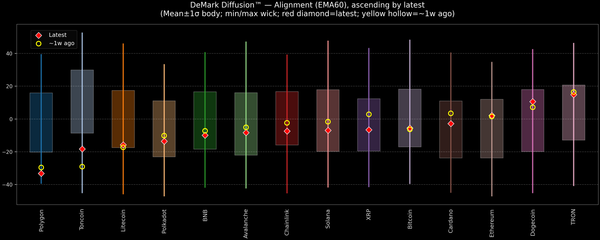
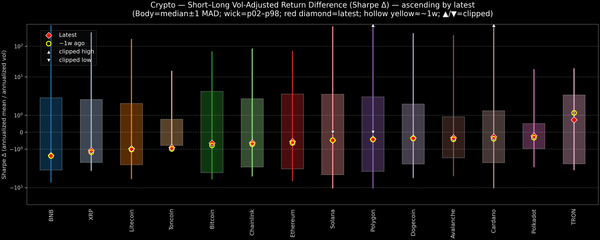
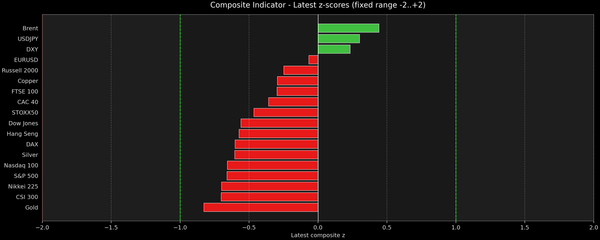
Thursday's session exhibited risk-off sentiment, with equity declines seemingly driven by ongoing fears of AI disruption. Stocks experienced sell-offs at the US opening and continued into the European close. Attention focused on an update from AI penny stock Algorhythm Holdings (RIME), indicating its SemiCab platform enables customers to scale freight volumes by 300-400% without increasing headcount. This primarily impacted the logistics/industrials sector, but other sectors exposed to AI disruption (software, gaming, financials) also declined, while sectors less exposed (consumer staples) outperformed. The risk-off sentiment boosted T-Notes, with the curve bull flattening led by the long end, peaking after a strong 30-year auction. Crude oil prices also decreased, tracking risk sentiment, but settled slightly above their lows. Geopolitically, Trump reiterated the need for a deal with Iran, potentially achievable within a month, but warned of significant consequences for Iran if no agreement is reached. Equity weakness extended to gold, silver, and crypto, assets that have shown similar performance recently, particularly during volatility. FX markets were relatively calmer, with haven currencies (Yen, Franc, and Dollar) outperforming and cyclical currencies lagging, especially the Aussie. Focus now shifts to the US CPI report on Friday.
US
CLAIMS: Initial Jobless Claims for the week ending February 7th decreased to 227k from 232k, but exceeded the forecast of 222k. The four-week average rose to 219.5k from 212.25k. Unadjusted data showed a decline of 4.5k to 248k, while seasonal factors anticipated a 1.1k increase. Continuing claims for the preceding week increased to 1.862 million from 1.844 million, surpassing the forecast of 1.85 million. Pantheon Macroeconomics suggests the data indicates a labor market as subdued as last year, casting doubt on the sustainability of January's payroll increase. However, they acknowledge that heavy snow in late January marginally increased claims. Looking ahead, they anticipate relatively lower layoffs in the coming months, but weak hiring.
EXISTING HOME SALES: Existing home sales for January decreased to 3.91 million from 4.27 million, significantly below the expected 4.18 million. Inventory of homes for sale was 1.22 million units, representing 3.7 months' worth (previously 3.3 months' worth), with the national median home price for existing homes increasing 0.9% Y/Y to USD 396,800. NAR Chief Economist Dr. Lawrence Yun noted that, "The below-normal temperatures and above-normal precipitation this January make it harder than usual to assess the underlying driver of the decrease and determine if this month’s numbers are an aberration”. Yun added that affordability is improving due to wage gains outpacing home price growth and lower mortgage rates compared to last year. However, supply remains low.
FIXED INCOME
T-NOTE FUTURES (H6) SETTLED 16+ TICKS HIGHER AT 112-25+
T-Notes were bid in risk-off trading amid concerns about further AI disruption. At settlement, 2-year notes were down 4.4bps at 3.468%, 3-year notes were down 5.8bps at 3.511%, 5-year notes were down 7.1bps at 3.670%, 7-year notes were down 7.5bps at 3.873%, 10-year notes were down 7.7bps at 4.106%, 20-year notes were down 8.1bps at 4.676%, and 30-year notes were down 8.3bps at 4.731%.
THE DAY: T-Notes traded within a 7-tick range throughout the Asian, European, and early US sessions, with some upside as US players entered and marginal downside after the jobless claims data, despite exceeding expectations. However, T-Notes rose sharply after the US equity opening bell, supported by risk-off trading. Equities were sold due to increased fears of AI disruption, with the logistics/industrial sector appearing to be the next affected. T-Notes increased from the US opening bell to the close of European cash equity trading, before fluctuating ahead of the 30-year auction. The auction was very strong, further boosting Treasuries into settlement. The next scheduled risk event is the US CPI on Friday, which will influence expectations for Federal Reserve rate cuts. The strong January jobs report led several banks to delay their forecasts for Fed rate cuts, with money markets now fully pricing in the next rate cut by July.
SUPPLY
Bills
- The US will sell USD 90 billion of 6-week bills, USD 89 billion of 13-week bills, USD 77 billion of 26-week bills, and USD 52 billion of 52-week bills on February 17th, all settling on February 19th.
- The US sold USD 105 billion of 4-week bills at a high rate of 3.630%, with a bid-to-cover ratio of 3.63x; and sold USD 95 billion of 8-week bills at a high rate of 3.630%, with a bid-to-cover ratio of 2.88x.
Notes
- Overall, a very strong auction. The US Treasury sold USD 25 billion of 30-year bonds at a high yield of 4.750%, stopping through the when-issued rate by 2.1bps, marking the largest stop-through since April 2025. This was stronger than the 0.1bps stop-through in January and better than the six-auction average of a 0.5bps tail. The bid-to-cover ratio increased to 2.66x from 2.36x, well above the 2.34x average. The strong auction was driven by an increase in indirect demand to 69.9% from 65.4%, above the 63.7% average. Direct demand rose to 24.2% from 23.5%, above the 23.9% average. This left dealers with only 5.9% of the auction, a better sign of demand compared to the prior 11.2% and 12.4% average.
- The US Treasury will sell USD 16 billion of 20-year bonds on Wednesday, February 18th, and USD 9 billion of 30-year TIPS on Thursday, February 19th.
STIRS/OPERATIONS
- Market Implied Fed Rate Cut Pricing: March 1.3bps (previous 0.0bps), April 4.2bps (previous 4.2bps), June 16.9bps (previous 16.4bps), December 52.3bps (previous 51bps).
- NY Fed RRP operation demand was at USD 2.844 billion (previous 1.05 billion) across 10 counterparties (previous 6).
- The NY Fed stated that the desk plans to conduct an additional approximately USD 40 billion in reserve management purchases and approximately USD 13.4 billion in reinvestment purchases between February 13th and March 12th.
- EFFR was at 3.64% (previous 3.64%), with volumes at USD 104 billion (previous 92 billion) on February 10th.
- SOFR was at 3.65% (previous 3.63%), with volumes at USD 3.194 trillion (previous 3.132 trillion) on February 10th.
CRUDE
WTI (H6) SETTLED USD 1.79 LOWER AT 62.84/BBL; BRENT (J6) SETTLED USD 1.88 LOWER AT 67.52/BBL
The crude complex declined amid broad risk-off sentiment and a recovery in the Dollar. The energy sector was largely range-bound overnight and initially through the European morning, with WTI and Brent reaching peaks of USD 65.10/bbl and 69.85/bbl, respectively. Benchmarks then weakened, coinciding with the latest IEA forecasts, which lowered the 2026 global oil demand growth forecast to 850k BPD (previous 930k BPD) and the 2026 global oil supply growth forecast to 2.4 million BPD (previous 2.5 million BPD). Subsequently, oil edged lower before succumbing to the overall dramatic shift in risk sentiment and the Dollar's recovery, plunging to session lows and settling around those levels. There was little crude-specific news behind the drop, just broader AI concerns fueling risk-off trading, although a report from Axios that Israel PM Netanyahu said the conditions Trump is setting on Iran, combined with their understanding they made a mistake last time by not reaching a deal, could lead Iran to accept a good deal, did aid a few downticks. Recently, US President Trump said they have to make a deal with Iran, and could reach deal over the next month, but will be very traumatic for Iran if they do not agree to a deal. Looking ahead, the US CPI on Friday is the key event.
EQUITIES
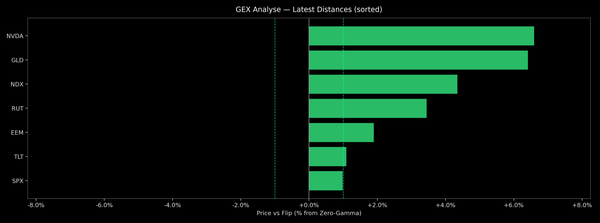
CLOSES: SPX -1.55% at 6,834, NDX -2.04% at 24,688, DJI -1.34% at 49,452, RUT -2.15% at 2,612
SECTORS: Utilities +1.50%, Consumer Staples +1.28%, Real Estate +0.31%, Health -0.17%, Industrials -1.20%, Communication Services -1.46%, Materials -1.49%, Consumer Discretionary -1.58%, Financials -1.99%, Energy -2.17%, Technology -2.65%.
EUROPEAN CLOSES: Euro Stoxx 50 -0.27% at 6,019, Dax 40 -0.11% at 24,828, FTSE 100 -0.67% at 10,402, CAC 40 +0.33% at 8,341, FTSE MIB -0.62% at 46,223, IBEX 35 -0.82% at 17,897, PSI -0.49% at 9,026, SMI -0.21% at 13,543, AEX -2.02% at 989.
STOCK SPECIFICS:
- Applovin (APP): Results were impressive, but desks noted they fell short of buy-side estimates.
- Cisco (CSCO): Issued guidance that only met expectations, disappointing traders, despite reporting better-than-anticipated quarterly results.
- Equinix (EQIX): Provided a strong outlook for the next quarter and fiscal year.
- iPhone (AAPL) is seeing growth in China in January.
- Kioxia issued a stellar outlook, reflecting a surge in NAND flash memory prices and strong demand for data storage needed for AI. This is noteworthy for MU, SNDK, STX, and WDC.
- McDonald's (MCD): EPS, revenue, and comparable sales all impressed.
- Motorola (MSI): EPS and revenue topped expectations with a stronger-than-expected fiscal year outlook.
- Tyler Tech (TYL): Top and bottom lines were light, as was the fiscal year revenue midpoint guide.
- Google (GOOGL): Updated Gemini 3 deep think in close partnership with scientists and researchers to tackle research challenges.
- Algorhythm Holdings (RIME): Announced that its SemiCab platform in live customer deployments is enabling its customers' internal operations to scale freight volumes by 300-400% without an increase in headcount.
FX
The Dollar Index showed only marginal strength on Thursday but is well off earlier lows. The Dollar reversed course as risk sentiment soured through the US afternoon. While moves in the FX space were more contained than in equities and precious metals, the Dollar did reverse earlier losses as potential further AI disruption fears emerged. As a result, AUD, CAD, and NZD weakened, while haven currencies, Yen and CHF, outperformed, with USD/JPY falling to approximately 152.35 from approximately 153.75 before the AI-induced fallout. Regarding Dollar-specific news, initial jobless claims marginally decreased to 227k from 231k, but were above the expected 222k, although little move was seen in the Greenback. All participants await the US CPI on Friday, which will provide a gauge on the inflationary side of the mandate, following the strong jobs market report on Wednesday. Given the latter, many banks have pushed back their Fed calls for rate cuts to resume, with money markets now pricing in the first 25bps reduction by July, versus June pre-NFP.
As mentioned, haven currencies topped the G10 breakdown, and high-beta FX lagged as risk sentiment soured. This occurred as Algorhythm Holdings announced that its SemiCab platform in live customer deployments is enabling its customers' internal operations to scale freight volumes by 300-400% without an increase in headcount, causing the Industrials sector to be the latest to suffer from AI disruption. More broadly, it seemed to ignite existing concerns in other sectors, such as software, gaming, and brokerage, regarding new AI platforms. Prior to this, the Kiwi led G10 gains while the Aussie lagged slightly, consolidating after recent outperformance as moves were Dollar-driven, with no major domestic catalysts for either currency. For the Yen, overall conditions remain supportive as markets continue to price faster BoJ normalization.
EUR and GBP were flat in a choppy day, as the Pound saw a mixed reaction to the latest GDP data. December M/M printed in line, while Y/Y and Q4 preliminary figures undershot expectations, briefly weighing on Cable before swiftly reversing.