Market Wrap 2026-03-05


Today's US Market Wrap — Key Points
- Market declines amid Mideast tensions, rising yields, stronger Dollar.
- Focus shifts to Friday's US payrolls report for labor market insights.
- Crude oil surges on geopolitical risks, Strait of Hormuz concerns.
- AI chip export restrictions impact tech stocks; job cuts announced.
Already a member? Sign in to unlock the full wrap
- SNAPSHOT: Stocks declined, Treasury yields increased, crude oil prices rose, the Dollar strengthened, and gold prices decreased.- REAR VIEW: Reports indicated China is negotiating with Iran to ensure secure passage of oil and gas through the Strait of Hormuz. US Challenger job cuts decreased, initial and continued jobless claims remained within recent ranges, import prices and unit labor costs exceeded expectations, while export prices aligned with forecasts. The US is drafting a rule requiring licenses for global AI chip exports. WTI crude surpassed $80/bbl for the first time since January 2025. The NBP Governor is reportedly considering gold sales to fund defense. China reduced its 2026 GDP growth forecast. ORCL is reportedly planning thousands of job cuts due to rising data center costs.- COMING UP: Data releases include German Factory Orders (January), Eurozone GDP 3rd Estimate (Q4), US Non-Farm Payrolls (February), and Retail Sales (January). Scheduled speakers include ECB President Lagarde, Cipollone, Schnabel; Fed’s Goolsbee, Daly, Collins, Hammack; and RBA’s Hauser. Australia will issue supply. Credit reviews include Fitch on France and DBRS on Greece.- NEWSQUAWK NFP PREVIEW: The February jobs report is anticipated to show an addition of 59,000 jobs in the US economy, a decrease from the 130,000 added in January but slightly above the 50,000 breakeven estimate.
More Newsquawk:- 1. Subscribe to the free premarket movers reports- 2. Trial Newsquawk’s premium real-time audio news squawk box for 7 days## MARKET WRAP
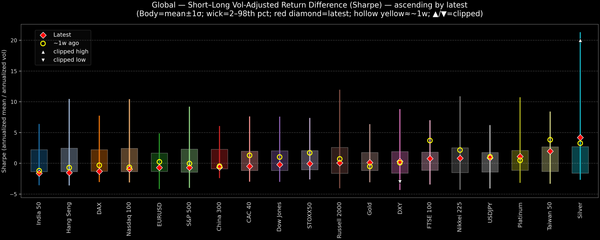
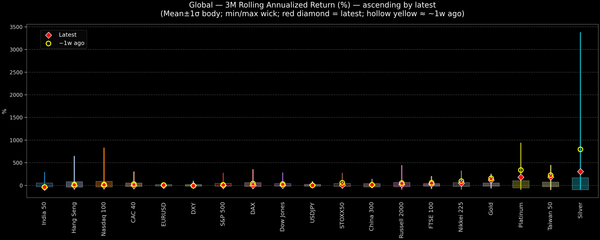
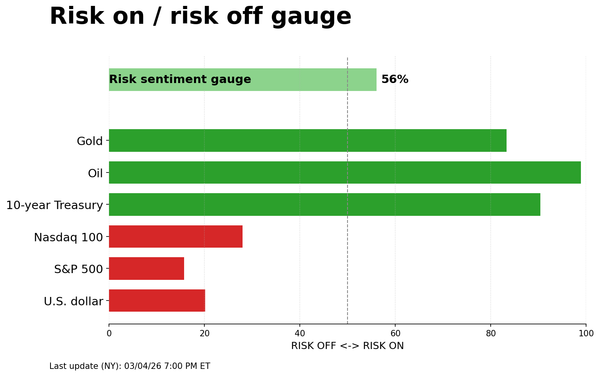
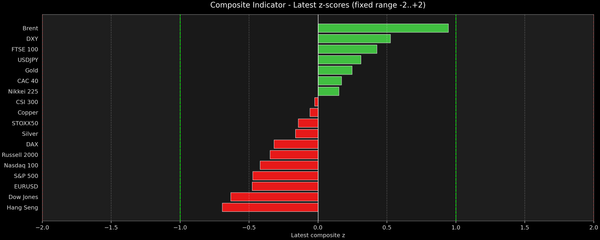
US indices experienced selling pressure amid escalating Middle Eastern tensions, although they recovered from session lows into settlement following reports of China's discussions with Iran to allow safe passage of oil and gas through the Strait of Hormuz. Subsequently, crude oil prices and the Dollar pared some gains, while spot gold and Treasury yields edged off their lows. WTI and Brent crude still registered notable gains due to geopolitical concerns and ongoing worries about reduced traffic in the Strait of Hormuz. Overall, trading reflected a risk-off sentiment as participants continued to react to the Middle Eastern conflict, with no immediate signs of de-escalation. While headlines regarding the conflict remained prevalent and fluid, there were few fundamentally "new" developments. Spot gold declined, impacted by reports that the NBP is considering gold sales for defense funding. Treasury yields increased as energy prices continued to rise. Equities were broadly weaker, with Energy being one of the few sectors to gain, while Consumer Staples and Materials underperformed. Broadcom reported strong earnings, while Nvidia and AMD experienced weakness following reports that the US is drafting a rule requiring licenses for global AI chip exports, potentially affecting NVDA and AMD shipments to all countries. US data releases had limited impact, with focus shifting to the US payrolls report on Friday.## US
CHALLENGER LAYOFFS:
US employers announced 48,307 job cuts in February, down from 108,435 in January. Technology sector layoffs totaled 11,039, attributed to factors including AI, global regulatory concerns, a slowdown in digital advertising due to tariffs and economic uncertainty, and higher costs. Andy Challenger noted that February's decrease is a welcome reprieve from the elevated job cut plans at the start of the year, but cautioned that increasing US involvement in the Iranian war may lead to more layoff plans as companies tighten budgets amid uncertainty and higher costs. Traders are awaiting the US payrolls report on Friday for further insights into the US labor market.
IMPORT/EXPORT PRICES:
Import prices increased by 0.2% M/M in January, matching expectations, while Y/Y they decreased by 0.1%. Weak fuel prices continued to suppress headline import prices, with fuel import prices falling 2.2% in January, while nonfuel import prices rose 0.5%. Despite the impact of weak fuel prices, prices for other imported goods continued to rise. Import prices were still down 0.1% Y/Y, but risks are tilted toward higher import prices in 2026 due to higher global oil prices, strong demand for capital goods imports, and past dollar depreciation. Oxford Economics anticipates core inflation to moderate, allowing the Federal Reserve to lower interest rates in June and September. Export prices rose 0.6% M/M in January, with Y/Y rising 2.6%.
UNIT LABOUR COST PRELIM (Q4):
Unit labor costs in the nonfarm business sector increased by 2.8%, exceeding the expected 2.0%, reversing from the prior 1.8% decline. This reflected a 5.7% rise in hourly compensation and a 2.8% increase in productivity. Nonfarm business sector labor productivity increased 2.8% as output rose 2.6% and hours worked fell 0.2%. Pantheon Macroeconomics suggests that the growth in unit labor costs is consistent with the 2% inflation target.
JOBLESS CLAIMS:
Initial Jobless Claims for the week ending February 28th were unchanged at 213,000, marginally below the 215,000 forecast. The four-week average fell by 4,750 to 215,750, while the unadjusted claims rose 18,800 to 213,000. Seasonal factors anticipated an 18,900 increase. New York saw a notable increase of 17,400 of the unadjusted increase, while Michigan saw an increase of 4,000. The largest drop in unadjusted claims was in Rhode Island (-1,600), and Oklahoma (-1,400). Continued Claims, for the preceding week, rose to 1.868 million from the prior 1.822 million, above the 1.850 million forecast. The four-week average was 1.851 million, +6,750, while the unadjusted continued claims rose 70,500 to 2.208 million. Seasonal factors expected an increase of 16,400. The number of weekly initial claims has remained steady in 2026, within a 199,000-232,000 range, continuing to show evidence of a low-hire, low-fire economy. The Fed is not expected to resume with rate cuts until the summer, but a sustained increase in the price of oil following the Iranian war may push expectations back, barring a substantial weakening in the labor market, which has stabilised recently. Pantheon Macroeconomics warns that "Past experience suggests the blizzard which battered the north east between February 24 and 26 will lift claims over the next two weeks. But permanent layoffs look set to remain low over the coming months."## FIXED INCOME
T-NOTE FUTURES (M6) SETTLED 16 TICKS LOWER AT 112-10
T-notes declined as energy prices continued to rise, with attention turning to the NFP report on Friday.
At settlement, the 2-year yield increased by 3.1bps to 3.574%, the 3-year yield increased by 4.4bps to 3.591%, the 5-year yield increased by 4.7bps to 3.716%, the 7-year yield increased by 4.7bps to 3.910%, the 10-year yield increased by 4.3bps to 4.125%, the 20-year yield increased by 3.9bps to 4.706%, and the 30-year yield increased by 2.2bps to 4.739%.
THE DAY:
T-notes experienced declines across the curve on Thursday, driven by rising inflationary fears following increases in energy prices. The move may have also been influenced by European assets, with European natural gas prices continuing to rise as markets reassess ECB rate expectations. There is now a 75% probability of a hike from the ECB by year-end vs 25% on Tuesday. Concerns are also growing that the Fed may delay the resumption of rate hikes if energy prices persist, potentially impacting consumer prices, especially if supply chains are disrupted. Rabo argues that under Fed Chair Powell, the Fed will maintain a wait-and-see approach, requiring more data and making a rate cut in March or April highly unlikely. However, under Warsh, the scenario may be different. Rabo suggests Warsh may try break the FOMC's indecision and push for rate cuts at his first meeting in June, arguing the Fed should look through temporary effects of energy prices on inflation. Data released today showed initial jobless claims unchanged W/W while continued claims rose. Challenger Layoffs dropped to 48k from 108k, while the RevelioLabs NFP report saw a decline of 16.7k jobs vs the Revelio report in January, which saw a -13.3k drop. Import prices were in line at 0.2%, while export prices rose 0.6%, matching the upwardly revised pace in January (initially 0.3%). Unit Labor Costs were hot while productivity also came in above expectations, but cooled from the prior pace. The data had little impact on T-notes with focus on geopolitics, but attention turns to the NFP report due Friday, particularly to see if the strength seen in January holds, which will help shape Fed rate cut expectations.
SUPPLY
Notes- US to sell USD 58bln of 3-year notes, USD 29bln of 10-year notes and USD 22bln of 30-year bonds on March 12th; all to settle on March 16th
Bills- US sold 4-wk bills at a high-rate of 3.640%, B/C 2.89x; sold USD 8-wk bills at a high-rate of 3.630%, B/C 3.21x- US to sell USD 89bln of 13-week bills and USD 77bln of 26-week bills on March 9th; to sell USD 90bln of 6-week bills on March 10th; All to settle March 12th.
STIRS/OPERATIONS- NY Fed RRP op demand at 2.79bln (prev. 0.88bln) across 5 counterparties (prev. 8) on March 5th- SOFR at 3.67% (prev. 3.70%), volumes at USD 3.292tln (prev. USD 3.31tln) on March 4th- EFFR at 3.64% (prev. 3.64%), volumes at USD 106bln (prev. USD 101bln) on March 4th- Treasury Buyback (Liquidity Support, 10- to 20-year, Max 2bln): Accepts 2.0bln of USD 17.844bln offered, accepts 2 of 37 eligible issues## CRUDE
WTI (J6) SETTLED USD 6.35 HIGHER AT 81.01/BBL; BRENT (K6) SETTLED USD 4.01 HIGHER AT USD 85.41/BBL
The crude complex surged amid the ongoing and escalating Middle Eastern conflict.
WTI and Brent crude prices increased on Thursday, reaching highs of USD 81.64/bbl and USD 85/bbl, respectively, from earlier lows of USD 74.97/bbl and USD 81.50/bbl. WTI is now approximately USD 13.50/bbl higher than last Friday's close. Regarding the Middle East, focus remains on the Strait of Hormuz and the flow of oil, given its critical importance to global supply. Israel's representative to the UN stated that they will sink Iranian ships in the Strait of Hormuz, giving them a few more days, and that it will be much harder for Iran to disrupt vessels coming through the Strait of Hormuz. As much as 20 million BPD of oil supply is at risk due to the ongoing blockage of the Strait of Hormuz. ING notes that Saudi Arabia and the UAE have the capacity to divert up to 5 million BPD via pipeline to avoid it, but still leaves 15 million bbls at risk. Looking ahead, attention remains on the Middle East, but the latest US jobs report will be monitored on Friday for insights into the health of the US labor market.## EQUITIES
CLOSES:
SPX -0.56% at 6,831, NDX -0.29% at 25,020, DJI -1.61% at 47,955, RUT -1.91% at 2,586
SECTORS:
Consumer Staples -2.43%, Materials -2.27%, Industrials -2.21%, Health -1.98%, Real Estate -1.01%, Utilities -0.76%, Communication Services -0.65%, Financials -0.49%, Consumer Discretionary +0.26%, Technology +0.39%, Energy +0.59%.
EUROPEAN CLOSES:
Euro Stoxx 50 -1.46% at 5,785, Dax 40 -1.78% at 23,774, FTSE 100 -1.45% at 10,414, CAC 40 -1.49% at 8,046, FTSE MIB -1.61% at 44,609, IBEX 35 -1.38% at 17,245, PSI +0.01% at 8,932, SMI -1.48% at 13,311, AEX -0.45% at 996.
STOCK SPECIFICS:- Broadcom (AVGO): Reported EPS and revenue beats, announced a $10 billion share buyback program, and provided strong next quarter outlook.- Nvidia (NVDA): Halted production of China-bound H200 AI chips and reallocated manufacturing capacity at TSMC to its next-generation Vera Rubin hardware.- Berkshire Hathaway (BRK.B): Commenced repurchasing shares, and CEO Greg Abel purchased $15 million in stock.- The Trade Desk (TTD): OpenAI had preliminary discussions with Trade Desk regarding selling ads.- Iren (IREN): Announced an up to $6 billion "at-the-market" equity share sell program and an agreement to purchase over 50,000 NVDA B300 GPUs to expand AI Cloud capacity.- Morgan Stanley (MS): Is laying off 2,500 employees, with layoffs linked to shifting business priorities and individual job performance.- Bear Cave issued a negative report on Serve Robotics (SERV).- The US is drafting a rule requiring licenses for global AI chip exports, potentially affecting Nvidia (NVDA) and AMD (AMD) shipments to all countries.- Oracle (ORCL) is reportedly planning thousands of job cuts due to rising data center costs, and its Cloud unit is pausing job hirings.- Iran targeted Microsoft (MSFT) data centers in drone strikes.- OpenAI unveiled new financial-services tools, rivalling anthropic OpenAI; releases GPT-5.4 model to field more Office tasks.## FX
The Dollar's safe-haven appeal was renewed on Thursday as oil prices surged to new highs, driven by market anxiety as the weekend approached without a resolution to the Middle East conflict. US data had little impact, with attention focused on attacks on energy facilities, continued conflict, and a vacant Strait of Hormuz. Later in the afternoon, reports that China is in talks with Iran to allow safe oil and gas passage through the Strait of Hormuz, following reports that Iran has said that only Chinese vessels will be allowed to pass through the Strait of Hormuz, led to a risk-on appetite across markets, weakening the Dollar and causing equities and precious metals to recover from their lows. US data showed initial claims signaling no imminent concerns, while continuing claims remained within YTD ranges. Unit Labor Costs exceeded expectations in Q4, export prices were strong, and import prices met forecasts. Challenger Job Cuts eased in February. The DXY reached highs of 99.41 before falling back to around 99.05.
AUD and NZD were sold due to geopolitical risks, weaker metal prices, and China's reduced 2026 GDP growth forecast, which dampened enthusiasm for the high-beta FX.
GBP relatively outperformed in the G10 space. ING noted that GBP outperformance vs EUR comes as asset managers unwind long EUR positions and markets push back on near-term BoE cuts. Cable bounced off lows of 1.3298 to ~1.3368 while AUD/USD hit as low as 0.6974
EUR/USD remained modestly weighed down by geopolitical/energy concerns, but with participants increasing bets for an ECB rate hike by year end to 75%, weakness was limited.## More markets stories on ZeroHedge
## Futs Jump On Reports About Iran's Willingness To Give Up Uranium Stockpile
## US, Ecuador Launch Joint Military Operations Against Terrorist Organizations
## Stocks Tumble On Report US Plans Licenses For Global Chip Exports
## Want more of the news you won't get anywhere else?
## Sign up now and get a curated daily recap of the most popular and important stories delivered right to your inbox.