Market Wrap 2026-03-10


Today's US Market Wrap — Key Points
- US equities declined amid Middle East tensions and fluctuating oil prices.
- Geopolitical risks in the Strait of Hormuz drove market volatility.
- Upcoming US CPI data and OPEC meeting are key market events.
- Treasuries mixed; focus on energy prices and upcoming auctions.
- AUD outperformed; Dollar mixed; European currencies weakened.
Already a member? Sign in to unlock the full wrap
MARKET SNAPSHOT
- Equities: Down
- Treasuries: Mixed
- Crude Oil: Down
- US Dollar: Up
- Gold: Up
REAR VIEW
- Reports indicated Iran may have started deploying mines in the Strait of Hormuz.
- Trump stated he had not seen such reports but threatened significant military action if mines were present and not removed.
- US Energy Secretary Wright, in a subsequently deleted post, claimed the US Navy escorted an oil tanker through the Strait of Hormuz (later denied by White House officials).
- IEA meeting reportedly concluded without a decision on releasing crude stockpiles.
- A weak US 3-year note auction occurred.
- US existing home sales increased in February.
- An oil tanker explosion occurred near Abu Dhabi.
- AMZN reportedly received approximately $126 billion in orders for its US bond sale.
COMING UP
- Data: German HICP Final (Feb), US CPI (Feb).
- Events: OPEC MOMR.
- Speakers: ECB's de Guindos, Schnabel; BoE's Breeden; Fed's Bowman.
- Supply: Australia, Japan, Germany, US
MARKET WRAP
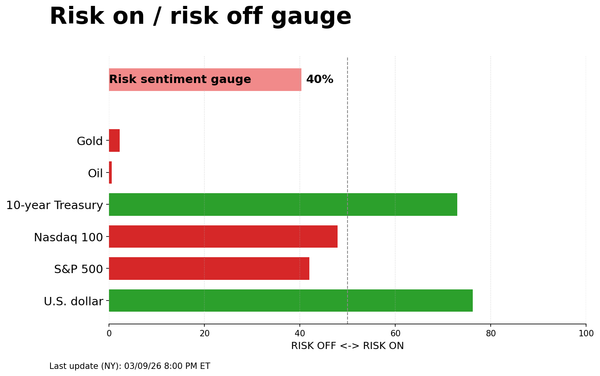
US indices closed with slight declines, influenced by conflicting Middle East news. Initial market sentiment was risk-on, following Trump's previous comments suggesting a swift end to the conflict, boosting gold and stocks while weakening the Dollar and oil, which aided Treasuries. However, Secretary of War Hegseth's statement about intensified strikes on Iran contradicted this optimism. The decline in oil prices was briefly accelerated by US Energy Secretary Wright's now-deleted post about a US Navy escort in the Strait of Hormuz. The reversal of these moves coincided with reports of US intelligence observing potential Iranian mine deployments in the Strait of Hormuz, a development seen as a significant escalation. Subsequently, Trump warned of severe military consequences if Iran placed mines in the Strait and demanded their immediate removal. The Dollar experienced modest gains, while the Australian Dollar (AUD) was the strongest G10 currency due to hawkish RBA commentary. Treasuries weakened, impacted by the poor auction. Precious metals maintained gains, albeit below their peaks, as focus remained on Middle East developments and the upcoming US CPI data.
FIXED INCOME
T-NOTE FUTURES (M6) SETTLED 3 TICKS HIGHER AT 112-14+
T-notes were mixed as oil price fluctuations influenced trading. At settlement: 2-year -1.4bps at 3.578%, 3-year -1.8bps at 3.593%, 5-year -1.4bps at 3.722%, 7-year -0.8bps at 3.920%, 10-year +0.6bps at 4.140%, 20-year +2.0bps at 4.737%, 30-year +3.5bps at 4.774%.
THE DAY: T-notes exhibited mixed performance, with energy prices again being a key driver. The curve initially bull steepened, reversing some of the flattening seen amid Middle East tensions, as oil prices retreated from recent highs following Trump's remarks. Corporate bond issuance was substantial, with Amazon (AMZN), Salesforce (CRM), and Honeywell (HON) seeking to raise USD 25-30 billion, USD 25 billion, and USD 16 billion, respectively, setting a new record for single-day corporate bond issuance. T-note futures reached lows after the Amazon offering and the ADP report. The 3-year auction was weak, tailing by 1.1bps, ahead of the 10- and 30-year auctions later in the week. Short-end yields rose following a rebound in oil prices and growing skepticism about the US Navy escorting oil tankers in the Strait of Hormuz after reports of potential Iranian mine deployments. Existing home sales rose 1.7% M/M to 4.09 million, exceeding the forecast of 3.89 million. The Weekly ADP Employment change increased to 15.5k from 12.75k. The BofA Consumer Checkpoint Survey indicated strong spending growth, reaching a three-year high.
SUPPLY
Notes
- USD 58 billion of 3-year notes tailed by 1.1bps.
- The 3-year auction was weak, with a 1.1bps tail, the first since August 2025. The previous auction had a 0.1bps stop-through, and the six-auction average was a 0.6bps stop-through. The bid-to-cover ratio was 2.55x, below the previous 2.62x and the average of 2.69x. Directs took 20.7% (previous 31.9%, average 25.3%), Indirects took 59.8% (previous 57.1%, average 64.3%), and Dealers were left with 19.5% (previous 10.9%, six-auction average 10.5%).
- The US will sell USD 58 billion of 3-year notes on March 10th, USD 29 billion of 10-year notes on March 11th, and USD 22 billion of 30-year bonds on March 12th, all settling on March 16th.
Bills
- The US Treasury will sell USD 69 billion of 17-week bills on March 11th, USD 100 billion of 4-week bills, and USD 90 billion of 8-week bills on March 12th, all settling on March 17th.
- The US sold 6-week bills at a high rate of 3.635%, with a bid-to-cover ratio of 2.98x.
STIRS/OPERATIONS
- Fed Rate Cut Pricing: March 0bps, April 1.7bps, June 9.8bps, December 39bps.
- NY Fed RRP op demand at USD 0.28 billion across 4 counterparties.
- SOFR at 3.65%, volumes at USD 3.173 trillion on March 9th.
- EFFR at 3.64%, volumes at USD 99 billion on March 9th.
- Treasury Buyback (Cash Management, 1-month to 2-year, max. USD 15 billion): USD 14.697 billion accepted out of USD 40.989 billion offered; 24 out of 52 eligible issues accepted.
- NY Fed Reserve Management T-bill Purchases (Maturity July 16th 2026 -February 18th 2027): USD 6.676 billion accepted out of 32.133 billion offers.
CRUDE
WTI (J6) SETTLED USD 11.32 LOWER AT 83.45/BBL; BRENT SETTLED USD 11.16 LOWER AT 87.80/BBL
Crude oil prices declined significantly, primarily driven by Trump's comments suggesting a potential end to the conflict, made after the settlement on the prior day. WTI and Brent crude fell to approximately USD 81/bbl and USD 84/bbl, respectively, in late trading on the previous day. The decline continued, reaching lows of 76.73 and 81.16, respectively, before partially recovering into settlement. Trump stated that any Iranian action to disrupt oil flow in the Strait of Hormuz would be met with a response "TWENTY TIMES HARDER". The Strait of Hormuz remained a critical point for global supply, leading to volatile price action. US Energy Secretary Wright's post on X, stating that the US Navy had escorted an oil tanker through the Strait of Hormuz, initially caused significant weakness, but prices recovered after Wright deleted the post and White House officials denied the escort. Further contributing to the recovery was a report that US intelligence had observed indications of potential Iranian mine deployments in the Strait of Hormuz. Additionally, a report indicated that the IEA meeting concluded without a decision on releasing crude stockpiles.
EQUITIES
CLOSES : SPX -0.21% at 6,781, NDX -0.04% at 24,956, DJI -0.07% at 47,707, RUT -0.22% at 2,548
SECTORS: Energy -1.32%, Health -0.73%, Utilities -0.65%, Industrials -0.57%, Financials -0.55%, Real Estate -0.16%, Materials -0.15%, Consumer Staples -0.13%, Consumer Discretionary -0.01%, Technology +0.08%, Communication Services +0.26%.
EUROPEAN CLOSES : Euro Stoxx 50 +2.73% at 5,841, Dax 40 +2.25% at 23,935, FTSE 100 +1.59% at 10,412, CAC 40 +1.79% at 8,057, FTSE MIB +2.67% at 45,202, IBEX 35 +3.05% at 17,445, PSI +1.67% at 9,024, SMI +0.42% at 13,055, AEX +1.98% at 1,002.
STOCK SPECIFICS:
- Nvidia (NVDA) is developing an open-source AI agent platform, NemoClaw.
- Apple (AAPL) increased iPhone production in India by approximately 53% in 2025 to 55 million units and now manufactures about 25% of its iPhones there.
- BioNTech (BNTX) announced that its co-founders will leave to establish a new independent venture by the end of 2026.
- Kohl's (KSS) reported light revenue and maintained its midpoint FY profit outlook.
- TSMC (TSM) reported January and February revenue up 30% Y/Y, supported by AI infrastructure demand prior to the Middle East conflict.
- Hewlett Packard Enterprise (HPE) exceeded profit expectations and raised its networking revenue outlook due to a surge in enterprise AI server orders; quarterly revenue missed expectations.
- Bunge (BG) announced a USD 3 billion share repurchase program.
- Qualcomm (QCOM) was downgraded by BofA to 'Underperform' from 'Neutral'.
- Rivian Automotive (RIVN) was upgraded by TD Cowen to 'Buy' from 'Hold'.
- Boeing (BA) stated that wiring flaws will slow some 737 MAX deliveries, according to the WSJ, but maintained its delivery goal of 500 737 MAX planes this year.
- Salesforce (CRM) plans to sell up to USD 25 billion of bonds to fund buybacks.
FX
The Dollar exhibited mixed performance against major currencies, influenced by Middle East news. Optimism waned due to the late rebound in oil prices following reports of potential Iranian mine deployments in the Strait of Hormuz. This diminished hopes for efficient US Navy escorts of oil tankers through the Strait, and Trump's statement about a potentially stronger response to Iran was viewed as a significant escalation. The DXY rebounded from lows, turning positive, but remained below its highs of 98.939. The main drivers were geopolitical and energy-related. The upcoming February CPI data is expected to be overshadowed by recent events.
AUD outperformed, supported by improved risk sentiment, strength in base metals, positive Chinese data, expectations of an RBA rate hike, and comments from RBA’s Hauser about a "very genuine policy debate" at the upcoming meeting. AUD/USD reached new yearly highs of 0.7169 before retreating to 0.7134.
GBP, EUR, JPY, and CHF all underperformed with slight weakness. Currency-specific news was limited, and rate hike expectations for the BoE and ECB were reduced amid the pullback in oil prices.