Market Wrap 2026-03-18


Today's US Market Wrap — Key Points
- Geopolitical tensions (Iran, Qatar) drive oil surge, boosting USD.
- Hawkish Powell comments support USD, pressure stocks/bonds. Rate hike discussed.
- US PPI exceeds expectations, adding to inflation concerns.
- Central banks (ECB, BoE, SNB, Riksbank) expected to hold rates.
Already a member? Sign in to unlock the full wrap
Dollar gains as oil ascends higher while Powell leans hawkish
- SNAPSHOT: Equities decreased, Treasuries decreased, Crude increased, Dollar increased, Gold decreased
- REAR VIEW: The Federal Reserve maintained rates as anticipated, with Miran dissenting; Powell adopted a hawkish tone in the press conference; US PPI was higher than expected; Iran's South Pars gas field was attacked, with threats of retaliation against several energy facilities across the Gulf; QatarEnergy confirmed that Ras Laffan Industrial City sustained extensive damage from attacks; Iran confirmed the death of Security Chief Larijani; the Bank of Canada held rates as expected; EIA crude stocks unexpectedly increased; multiple Chinese companies reportedly received approval to purchase NVDA H200 AI chips.
- COMING UP: Data: Australian Jobs Report (Feb), UK Jobs/Average Earnings (Jan), US Initial Jobless Claims (Mar/14), Atlanta Fed GDP, New Zealand Trade Balance (Feb). Event: Riksbank, SNB, BoE, ECB, BoJ Policy Announcements. Speakers: RBNZ's Richardson; BoJ's Ueda; SNB's Schlegel; Riskbank's Thedeen; ECB's Lagarde. Supply: Spain, France, US.. Earnings: FedEx, Alibaba.
More Newsquawk in 2 steps:
- Subscribe to the free premarket movers reports
- Trial Newsquawk’s premium real-time audio news squawk box for 7 days
MARKET WRAP
Stocks experienced downward pressure, while yields increased in response to further gains in oil prices following an Israeli attack on the South Pars gas facility, the world's largest. Oil prices partially retreated as EU's Kallas and the Iranian Foreign Minister engaged in discussions, but these losses were quickly reversed when Qatar announced an attack on the Ras Laffan Industrial complex, resulting in significant damage. Concurrently, Israel reportedly targeted Iranian navy ships in the Caspian Sea. These reports drove oil prices higher after settlement, bolstering the dollar, weighing on stocks, and pushing yields upward. Federal Reserve Chair Powell also contributed to these market movements. The Federal Reserve maintained rates as expected, with an 11-1 vote, and the dot plots remained largely unchanged, resulting in minimal immediate reaction. However, alongside the aforementioned developments, Powell indicated that the Federal Reserve would not lightly dismiss energy-induced inflation, and mentioned that future rate hikes were discussed, although he clarified that this was not the base case for the majority of the Federal Reserve. The geopolitical escalations and Powell's hawkish stance supported the dollar, while stocks and bonds declined, and oil prices accelerated, with Brent surpassing USD 110/bbl at the time of this report. Elsewhere, US PPI data was higher than expected, and the Bank of Canada maintained rates as anticipated. Amid the stronger dollar, precious metals experienced downward pressure, with gold falling below USD 5k/oz to approximately USD 4,835 and silver to around USD 76/oz.
FED REVIEW
STATEMENT: The FOMC maintained rates at 3.50-3.75%, with no changes to the forward-guidance sentence regarding consideration of "the extent and timing of additional adjustments" or to its commitment to maximum employment and 2% inflation. In the vote, Miran dissented, favoring lower rates. Some expected Waller to join him, while others suggested Bowman might also dissent in favor of a rate cut. The March statement left the economic assessment largely unchanged, except that "the unemployment rate has shown some signs of stabilisation" was replaced with "the unemployment rate has been little changed in recent months". However, "economic activity has been expanding at a solid pace", "job gains have remained low", and "inflation remains somewhat elevated" were unchanged. In its risk assessment, January's reference that "uncertainty about the economic outlook remains elevated" was retained, while March added that "the implications of developments in the Middle East for the US economy are uncertain." Balance-sheet and implementation guidance were also unchanged.
SEP: The Federal Reserve increased its near-term and medium-term growth forecasts, raised its inflation projections, and slightly softened its labor-market outlook. GDP was revised upward to 2.4% (previously 2.3%) for 2026, 2.3% (previously 2.0%) for 2027, and 2.1% (previously 1.9%) for 2028. Long-term growth was revised upward to 2.0% from 1.8%. PCE and core PCE were both revised higher, with the most significant change in 2026, when both were raised to 2.7% from 2.4% and 2.5%, respectively. The unemployment projection remained unchanged for 2026 at 4.4%, but was slightly increased to 4.3% in 2027 from 4.2%. The median rates path was unchanged through 2028, although the longer-run fed funds rate edged up to 3.1% from 3.0%.
POWELL PRESSER: Fed Chair Powell's press conference took on a hawkish tone, despite the SEP median dots remaining unchanged. His primary concern appeared to be persistent inflation rather than weak growth. He repeatedly emphasized the need for further progress in goods disinflation, expressed concern over sticky non-housing services, and made it clear that rate cuts would not follow if inflation progress did not resume. He also expressed caution regarding potential upside inflation risks from tariffs, which he anticipates playing out by mid-year, as well as from oil and the Middle East. He emphasized that energy can only be overlooked if inflation expectations remain anchored, but it would not be dismissed lightly. Powell noted that several officials had observed an increase in short-term inflation expectations, while long-term inflation expectations were "solid," adding that the Federal Reserve was strongly committed to maintaining inflation expectations anchored around the target. Regarding rates, Powell maintained optionality but did not suggest near-term easing. He stated that policy was in a favorable position, noting that it was near the high end of neutral, or only modestly restrictive, suggesting that the threshold for cutting rates remained evidence-based rather than pre-emptive. He also highlighted a significant shift within the Committee toward fewer cuts and mentioned that a rate hike was discussed at the meeting, but emphasized that the "vast majority" did not view it as the base case. Finally, Powell stated that the labor market was being closely monitored, particularly weak private payroll growth, but stopped short of suggesting that employment risks now dominate the Federal Reserve's policy balance.
FED CHAIR JOB: Powell stated that if a successor is not confirmed before his term as Chair ends, he would remain in place as Fed Chair "Pro Tem". Regarding his role beyond that, he stated that he has no intention of leaving the Board of Governors until the DoJ investigation is concluded. Beyond that point, he has not yet decided whether he would stay on as a Governor once the probe is resolved.
US
PPI: Headline PPI increased by 0.7% M/M, exceeding the 0.3% forecast and matching the highest analyst estimate, accelerating from the previous 0.5%. This resulted in the Y/Y accelerating to 3.4% from the previous 2.9% and consensus, matching the highest analyst forecast. The core M/M increased by 0.5%, cooling from the previous 0.8%, while the Y/Y increased by 3.9%, accelerating from the previous 3.6% and exceeding the 3.7% forecast. The super core (excluding food, energy, and trade) increased by 0.5% M/M, also exceeding the 0.3% forecast and previous, while the Y/Y increased by 3.5%, exceeding the 3.3% forecast and 3.4% previous. Within the report, the PCE components leaned slightly hotter than the January report, with portfolio management fees cooling, air passenger transport rising marginally, and physician care easing. Home health and hospice care, and outpatient and inpatient care accelerated. Oxford Economics highlighted that the increase in food and energy prices pushed the headline to its highest level since February 2025, and there are upside risks ahead as the spike in oil prices means food and energy goods, along with transportation services, will likely see larger price increases in the next PPI report. Oxford Economics' PCE tracking nowcast "points to a 0.4% rise in both headline and core prices. This will keep headline PCE inflation steady at 2.8% and help core inflation inch lower to 3.0% from 3.1% in January".
BOC
BOC: The Bank of Canada maintained rates as expected at 2.25%, although it removed the line from January stating that the BoC "judges the current policy rate remains appropriate, conditional on the economy evolving broadly in line with the outlook". The BoC noted that growth risks are tilted to the downside, and inflation risks have risen due to energy prices, noting that the increased energy prices will push up total inflation in the coming months. It also expects growth to be weaker than anticipated at the January meeting. The Central Bank confirmed that it is too early to assess the impact of the conflict, but it remains prepared to respond as needed. The BoC may have removed the language about the current policy being appropriate due to the large amounts of uncertainty amid the conflict and trade environment, with the USMCA also up for review. Governor Macklem noted that the governing Council will look through the war’s immediate impact on inflation, but if energy prices stay high, the BoC will not let their effects broaden and become persistent inflation. He added that they will make decisions one meeting at a time, and he does not think there will be a rapid pass-through of higher energy prices. Money market pricing now indicates 36bps of hikes by year-end (previously 32bps before the meeting), with the first hike in October (previously December). IGN writes that given uncertainty over how long the situation will last and the continued focus on trade, "we see little prospect of a near-term rate move from the BoC".
FIXED INCOME
T-NOTE FUTURES (M6) SETTLED 14+ TICKS LOWER AT 111-17+
Yields are higher on escalating geopolitics, and as Fed Chair Powell says, rate hikes were discussed. 2-year +8.2bps at 3.760%, 3-year +8.6bps at 3.765%, 5-year +8.1bps at 3.869%, 7-year +7.4bps at 4.053%, 10-year +6.1bps at 4.261%, 20-year +4.9bps at 4.864%, 30-year +4.0bps at 4.883%.
THE DAY: T-notes experienced two-way trade but sold off during the US session as oil prices surged following Israel's attack on the South Pars gas field in Iran, the world's largest gas field, reigniting inflationary concerns seen in recent weeks. Meanwhile, the US PPI data came in hotter than expected, keeping T-notes pressured ahead of the Federal Reserve announcement. The Federal Reserve ultimately left rates unchanged in an 11-1 vote split, with only Miran opting to cut rates by 25bps. The median dot plots were largely unchanged, apart from a slight move higher in the long-run dot. Inflation and growth forecasts were raised, while unemployment was unchanged, apart from a revision higher to 2027. Some pressure in T-notes was observed throughout Powell's press conference, where he stated that the Federal Reserve would not lightly dismiss energy price spikes, while also revealing that rate hikes were discussed at today's meeting, but it is not the base case for the vast majority. These comments caused yields to move higher, but also supporting the move were the post-settlement gains in oil after Qatar announced Iran struck the Ras Laffan Industrial complex and extensive damage was caused.
SUPPLY
Notes
- US to sell USD 19bln of 10-year TIPS on March 19th; all to settle March 31st
Bills
- US sold 17-week bills at a high rate of 3.610%, B/C 3.05x
STIRS/OPERATIONS
- Fed Rate Cut Pricing: April +2.3bps (prev. +1.3bps), June +1.1bps (prev. -2.2bps), July -3.5bps (prev. -6.2bps), December -15.4bps (prev. -19.4bps); Priors are pre-FOMC.
- NY Fed RRP op demand at USD 0.698bln (prev. 0.797bln) across 6 counterparties (prev. 5)
- SOFR at 3.65% (prev. 3.70%), volumes at USD 3.146tln (prev. USD 3.178tln) on March 17th
- EFFR at 3.64% (prev. 3.64%), volumes at USD 93bln (prev. USD 88bln) on March 17th
CRUDE
WTI (K6) SETTLED USD 0.07 LOWER AT USD 95.46/BBL; BRENT (K6) SETTLED USD 3.96 HIGHER AT USD 107.38/BBL
Crude prices were mixed as attacks on Iran's energy facilities left concerns elevated over disruption to supply. WTI and Brent found their lows in the European morning, with the attack of Iran's South Pars gas field and Asaluyeh oil facility helping prices reverse and move rapidly into positive territory. Tensions grew after reports said Iran would hit enemy sites that were previously thought to be safe, issuing evacuation warnings for several energy facilities across the Gulf. Later, Axios reported that an Israeli official said the strikes on Iran's energy sites were aimed at signalling to Iran that if it continues to disrupt oil supply through the Strait of Hormuz, there could be an escalation in targeting of its energy facilities. Brent notably outperformed WTI on the day, but both came under pressure after reports that Iran's Foreign Minister spoke with EU's Kallas; where they discussed the regional situation and the Strait of Hormuz. WTI ended in negative territory, albeit notably off the USD 91.45bbl lows. Around WTI settlement, QatarEnergy confirmed that the Ras laffan Industrial City has been subjected to missile attacks, with extensive damage caused. WTI and Brent were lifted on the news, further paring the downside seen in response to the earlier meeting between Iran's FM and EU's Kallas. Elsewhere, no reaction was seen in response to the EIA weekly inventory report. Data was as follows: Crude 6.155mln (exp. -0.58mln), Gasoline -5.436mln (exp. -1.4mln), Distillate -2.527mln (exp. -1.5mln). WTI and Brent traded between USD 91.45-98.67bbl and 100.34-109.95, respectively. No reaction was seen to the Fed holding rates as expected.
EQUITIES
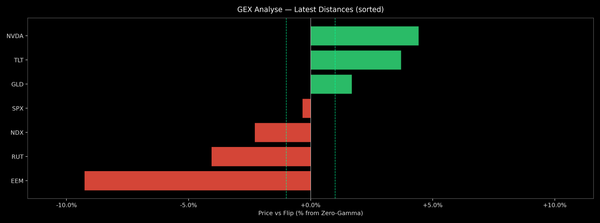
CLOSES: SPX -1.36% at 6,625, NDX -1.43% at 24,425, DJI -1.63% at 46,225, RUT -1.64% at 2,479
SECTORS: Consumer Staples -2.44%, Consumer Discretionary -2.32%, Materials -2.25%, Health -1.61%, Real Estate -1.61%, Technology -1.24%, Financials -1.18%, Communication Services -1.12%, Utilities -0.79%, Industrials -0.77%, Energy -0.16%.
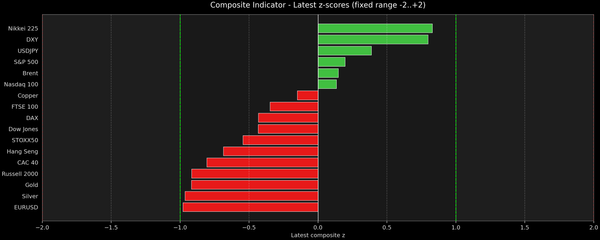
EUROPEAN CLOSES: Euro Stoxx 50 -0.54% at 5,738, Dax 40 -0.88% at 23,513, FTSE 100 -0.98% at 10,301, CAC 40 -0.06% at 7,970, FTSE MIB -0.37% at 44,721, IBEX 35 +0.20% at 17,282, PSI -0.44% at 9,135, SMI -1.60% at 12,756, AEX -1.27% at 1,000
STOCK SPECIFICS
- Nvidia (NVDA): CEO stated that the company has received orders from China for H200 processors.
- General Mills (GIS): Q profit missed expectations.
- Lululemon (LULU): Reported soft guidance.
- Macy's (M): Q metrics exceeded expectations.
- Rocket Lab (RKLB): Filed up to $1B ATM offering.
- Block (XYZ): Upgraded at Rothschild & Co Redburn to 'Neutral' from 'Sell'.
- Coinbase (COIN) is reportedly competing for a significant deal with Cloudflare (NET) to launch a stablecoin that could be central to agent-based traffic.
FX
The Dollar traded firmer on Wednesday, supported by Fed Chair Powell's hawkish stance, further energy disruption in the Middle East, and a higher-than-expected US PPI report. Initially, Israel's attacks on Iran's South Pars gas field and Asaluyeh oil facility led to a rally in crude prices, with Brent approaching USD 110/bbl. Meanwhile, PPI was higher than expected across all measures, adding to existing inflationary concerns, given that the report preceded the surge in oil prices in March and components that feed into PCE leaned slightly hot. In the afternoon, the Federal Reserve held rates as expected, with only Governor Miran dissenting in favor of a rate cut. The statement highlighted uncertainty surrounding the economic impacts from the Middle East situation, with dollar strength increasing during the press conference. Specifically, Powell stated that he would not lightly dismiss the question of overlooking oil prices and pointed out that the vast majority of participants do not see a hike as the next base case (1 does). Meanwhile, the main changes in the SEPs saw 2026, 27, and 28 GDP revised upward, as well as core and headline PCE for 2026. DXY climbed back above 100 to around 100.14 from earlier 99.465 lows.
USD/CAD showed little reaction to the Bank of Canada's decision to hold rates as forecasted. Moves in the currency pair were more influenced by US and geopolitical dynamics. The Bank of Canada removed the line stating that the current policy rate is about the right level to keep inflation close to 2% if the economy evolves as expected. This is likely due to the increased downside risks to growth and upside risks to inflation, the central bank pointed out, clouding the policy outlook in the year ahead.
Thursday is a significant day for G10 central banks, with the ECB, SNB, BoE, and Riksbank widely expected to hold rates. Policymakers are expected to emphasize data dependence and a wait-and-see approach as elevated energy prices persist into the third week of the conflict at their respective rate announcements. Early Friday, the BoJ is expected to hold rates amid a troubling situation with USD/JPY nearing 160 with no near-term solution in sight to combat higher energy prices.
Click below for G10 central bank Newsquawk previews.
More
markets stories on ZeroHedge